
How to Get Full Marks on WJEC/Eduqas Biology QER Questions
A complete guide to Quality of Extended Response questions — what examiners actually want, and how to give it to them.
Last updated: February 2025
Video tutorial coming soon
What Is a QER Question?
Every WJEC and Eduqas Biology exam paper contains at least one QER question, typically worth 9 marks. QER stands for Quality of Extended Response.
Here’s what catches most students out: unlike ordinary structured questions where you earn one mark per correct point, QER questions are marked using a banded mark scheme. The examiner reads your entire answer and decides which band it falls into.
| Band | Marks | What This Means |
|---|---|---|
| Band 3 | 7–9 marks | Excellent — articulate, integrated, sequential, complete, accurate vocabulary |
| Band 2 | 4–6 marks | Adequate — some structure, mostly relevant, but gaps or lack of flow |
| Band 1 | 1–3 marks | Limited — disorganised, significant gaps, weak vocabulary |
The critical difference: In a QER question, how you write matters as much as what you write. Two students can include the same biological facts but score in completely different bands because of the way those facts are organised and connected.
Decoding the Mark Scheme: What Examiners Actually Want
The Band 3 (7–9 marks) descriptor says:
Official Band 3 Descriptor
“The candidate constructs an articulate, integrated account, which shows sequential reasoning. The answer fully addresses the question with no irrelevant inclusions or significant omissions. The candidate uses scientific conventions and vocabulary appropriately and accurately.”
That’s one sentence packed with six separate requirements. Let’s break down exactly what each one means.
1. “Articulate”
Your answer needs to be clearly expressed and easy to follow. Each sentence should say what it means without ambiguity. The examiner shouldn’t have to guess what you intended.
| ✘ Not Articulate | ✔ Articulate |
|---|---|
“The enzyme gets denatured because of the temperature and then it can’t work because the shape changes and the substrate can’t fit.” Problem: One long, tangled sentence. Cause and effect are jumbled together. | “Above the optimum temperature, increased kinetic energy breaks the hydrogen bonds and ionic bonds that maintain the tertiary structure of the enzyme. The active site changes shape, so the substrate can no longer form an enzyme–substrate complex. The enzyme is denatured.” Clear: One idea per sentence, in logical order. |
How to practise: Read your answer back to yourself. If you need to re-read a sentence to understand it, rewrite it. Aim for one clear idea per sentence.
2. “Integrated Account”
Your points need to be woven together into a single, connected narrative — not a disconnected list of facts. Each point should lead naturally into the next.
| ✘ Not Integrated (a list) | ✔ Integrated (a connected account) |
|---|---|
“DNA is in the nucleus. mRNA is made. Ribosomes make proteins. tRNA carries amino acids. rRNA is in ribosomes.” Problem: Correct facts, but no connections. This reads like bullet points in sentences. | “DNA is located in the nucleus and provides the genetic code. During transcription, one strand of DNA acts as a template for the production of mRNA. The mRNA molecule therefore carries a complementary copy of the genetic code from the nucleus to the ribosomes in the cytoplasm, where it is used during translation.” Integrated: Each point leads logically to the next with linking phrases. |
The key skill: Use linking words and phrases that show how one idea connects to the next. Words like “this causes”, “which means that”, “as a result”, “therefore”, “consequently” are the glue that turns a list into an account.
Think of it this way: If someone could rearrange your sentences into any order and the answer would still make the same amount of sense, it’s a list, not an integrated account.
3. “Sequential Reasoning”
This is the most important phrase in the mark scheme. Your answer needs to follow a logical order where each step leads to the next, like links in a chain.
Sequential reasoning means you’re building an argument or a causal chain, not just listing things you know.
Example — Explaining tRNA activation (from a real WJEC QER question):
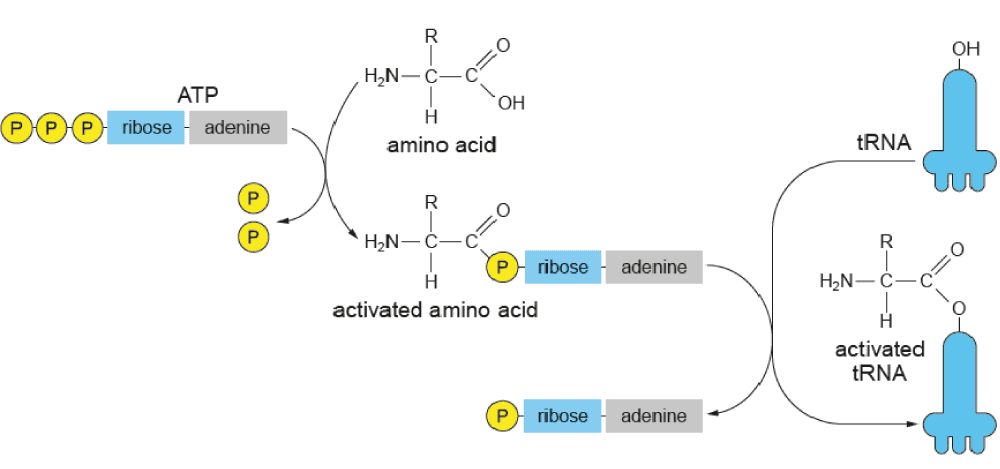
Image 7: tRNA activation. Source: WJEC/Eduqas A-Level Biology. © WJEC CBAC Ltd.
Notice that each numbered point is a cause, and the arrow after it is the consequence that leads to the next cause. If you removed step 2, step 3 wouldn’t make sense — that’s how you know the chain is genuinely sequential.
The test: Can you put the word “therefore” or “because” between every pair of sentences? If not, you may be listing, not reasoning.
4. “No Irrelevant Inclusions or Significant Omissions”
This is actually two separate requirements:
No significant omissions — You haven’t left out any major point. If the question asks about the function of all four nucleic acids and you only cover three, that’s a significant omission.
No irrelevant inclusions — Everything in your answer is directly relevant to the question asked. If the question asks about tRNA activation and you write about the full process of translation, that’s irrelevant material.
Why this matters: Examiners report that one of the most common reasons students are placed into Band 2 instead of Band 3 is the inclusion of material that wasn’t asked for. It suggests the student is writing everything they know rather than answering the specific question.
★ Before you start writing, underline the key words in the question. Ask yourself: What process? What structure? What organism or context? What am I being asked to do — describe, explain, or evaluate?
5. “Scientific Conventions and Vocabulary”
You need to use the correct biological terms, and use them correctly. This isn’t just about spelling — it’s about precision.
| ✘ Vague / Inaccurate | ✔ Precise / Accurate |
|---|---|
| “The blood cell eats the bacteria” | “The phagocyte engulfs the pathogen by phagocytosis” |
| “The DNA opens up and copies itself” | “Helicase unwinds the double helix and DNA polymerase catalyses the addition of complementary nucleotides” |
| “Energy is made in respiration” | “ATP is synthesised during oxidative phosphorylation” |
| “The shape of the enzyme is ruined” | “The tertiary structure of the active site is altered; the enzyme is denatured” |
The examiner’s perspective: Correct vocabulary isn’t just showing off. It tells the examiner that you genuinely understand the biology. A student who writes “energy is produced” will be penalised because energy isn’t produced — it’s transferred or released. That one word reveals a misconception.
The Five Most Common Reasons Students Score Band 2 Instead of Band 3
| # | The Mistake | Why It Costs You Marks |
|---|---|---|
| 1 | Writing a list, not an account | You include correct facts but don’t connect them. There are no linking words (“this causes”, “as a result”, “therefore”). The examiner sees isolated statements rather than a chain of reasoning. |
| 2 | Writing everything you know | The question asks about one specific thing and you also include related material “just in case.” This is an irrelevant inclusion and signals you haven’t read the question carefully. |
| 3 | Missing a key step | Your sequential reasoning has a gap. For example, you explain that temperature denatures enzymes but don’t explain why (bonds broken → active site shape changes → substrate cannot bind). The missing step breaks the chain. |
| 4 | Vague language | You write “it helps the body” instead of using precise terminology. Vague language puts you in Band 2 even if you know the biology. |
| 5 | Poor structure | You start explaining a process, then jump to something else, then come back. The examiner has to piece your answer together. Even if all the points are correct, a disorganised answer cannot score Band 3. |
Your QER Strategy: A Step-by-Step Approach
Follow this approach for every QER question and you’ll consistently hit Band 3.
Read & Underline
Underline the key words in the question. What is the question actually asking? What process, structure, or concept? What is the command word — describe, explain, or discuss? Circle the specific focus.
Plan Your Chain
In the margin, jot down a quick numbered list of the key steps. This takes 60–90 seconds and prevents you from missing steps or going off topic. Think: what is the logical starting point and endpoint?
Write with Linking Phrases
Follow your plan. Each sentence should contain one clear biological idea. Connect sentences with causal language: “this means that”, “as a result”, “consequently”, “which causes”. Use correct terminology throughout.
Check Against the Question
Read it back. Does every sentence directly address the question? Is there logical flow? Have you used correct terminology? Have you missed any key steps? If you removed a sentence, would the chain break?
Worked Example: A Band 3 Answer
This is a real WJEC/Eduqas QER question from a past paper:
Question (9 QER)
Describe the function of each of the four types of nucleic acid involved in protein synthesis and state where in the cell each carries out its function. (A detailed description of protein synthesis is not required.)
Using the information given, explain the role of ATP in the process shown in Image 7.
Image 7
Source: WJEC/Eduqas A-Level Biology. © WJEC CBAC Ltd.
Step 1 — Key words underlined:
four types of nucleic acid (must cover all four: DNA, mRNA, rRNA, tRNA), function (what each one does), where in the cell (location for each), role of ATP (must use the diagram information), not a detailed description (don’t write out all of translation).
Step 2 — Quick plan:
1. DNA = genetic code, nucleus. 2. mRNA = carries code, nucleus→ribosomes. 3. rRNA = ribosome structure, cytoplasm/RER. 4. tRNA = delivers amino acids, cytoplasm. 5. ATP activation from diagram.
Step 3 — The answer:
Band 3 Model Answer
Four types of nucleic acid are involved in protein synthesis: DNA, mRNA, rRNA and tRNA. Each has a distinct function and operates in a specific location within the cell.
DNA is located in the nucleus and provides the genetic code — the template for the sequence of amino acids in a polypeptide. During transcription, one strand of DNA acts as a template for the production of mRNA. The mRNA molecule therefore carries a copy of the genetic code from the nucleus to the ribosomes in the cytoplasm, where it is used during translation.
Ribosomes, which are found in the cytoplasm and on the rough endoplasmic reticulum, are composed partly of rRNA. The rRNA forms the ribosome and provides the site where translation takes place. During translation, tRNA molecules deliver specific amino acids to the ribosome in the cytoplasm. Each tRNA has an anticodon that binds to a complementary codon on the mRNA, ensuring that amino acids are assembled in the correct sequence.
Before tRNA can carry out its role, it must first be activated, as shown in Image 7. ATP provides energy for the reaction. Two phosphates are released. The amino acid reacts with ATP to form an activated amino acid. The amino acid is then transferred to tRNA, forming activated tRNA. The tRNA can now transport its specific amino acid to the ribosome.
Based on WJEC/Eduqas indicative content. © WJEC CBAC Ltd.
Why this scores Band 3:
| Criterion | Where It Appears |
|---|---|
| Articulate | Each sentence conveys one clear idea. No ambiguity or run-on sentences. |
| Integrated account | DNA and mRNA are linked (DNA is template → mRNA carries the code). rRNA and tRNA are linked (both function at the ribosome). tRNA activation is linked back to its role. |
| Sequential reasoning | Causal language throughout: “therefore”, “ensuring that”, “before…it must first”, “the energy released is used to”, “can now transport”. |
| No irrelevant inclusions | No detailed description of transcription or translation (as instructed). Everything addresses the question directly. |
| No significant omissions | All four nucleic acids covered with role + location. All mark scheme points about tRNA activation included. |
| Scientific vocabulary | Genetic code, template, transcription, translation, complementary, anticodon, codon, hydrolysis, inorganic phosphate, activated amino acid, activated tRNA–amino acid complex. |
Linking Phrases That Signal Sequential Reasoning
These phrases are your secret weapon. Use them to connect your biological ideas and show the examiner you’re building a logical chain.
Showing Cause & Effect
- This causes…
- This leads to…
- As a result…
- Consequently…
- Therefore…
- This means that…
Explaining Why
- This is because…
- This is necessary because…
- The reason for this is that…
- This is due to…
Showing a Sequence
- First… then…
- Following this…
- Subsequently…
- At this stage…
- The next step is…
Linking Structure to Function
- This is adapted for… because…
- The function of… is to…
- This increases… which means that…
Your QER Checklist
Use this checklist before you move on from every QER answer:
Before You Move On, Check…
- Have I underlined the key words in the question?
- Have I planned the logical sequence before writing?
- Does every sentence directly answer the question that was asked?
- Is each point connected to the next with a linking phrase (not just listed)?
- Could someone follow my reasoning from start to finish without getting lost?
- Have I used correct biological terminology for every structure, molecule, and process?
- Have I avoided vague language (“it”, “the thing”, “helps”, “gets rid of”)?
- Is there anything in my answer that wasn’t asked for? If so, cross it out.
- Have I missed any key step in the chain? Would removing any sentence break the logic?
Remember: A Band 3 answer isn’t about knowing more biology than a Band 2 answer. It’s about organising and connecting your biology so the examiner can see your understanding clearly. Plan, link, and be precise.
Frequently Asked Questions
A QER (Quality of Extended Response) question is a 9-mark question in WJEC/Eduqas A-Level Biology that tests your ability to construct a logical, scientific argument. Unlike regular questions where you get one mark per point, examiners assess your scientific accuracy, terminology, and the quality of your written reasoning using banded mark schemes (Band 1: 1-3 marks, Band 2: 4-6 marks, Band 3: 7-9 marks).
A 9-mark QER answer should typically be 200-300 words, taking approximately 12-15 minutes to write. Structure it with 3-4 detailed scientific paragraphs that flow logically, using key terminology throughout and linking your points together with causal language.
No, avoid bullet points in QER answers. The mark scheme specifically looks for an ‘integrated account’ with ‘sequential reasoning’ — your answer needs to flow as connected prose, not as a disconnected list. Using bullet points will likely place you in Band 2 (4-6 marks) rather than Band 3 (7-9 marks).
For Band 3 (7-9 marks), examiners look for six things: 1) Articulate writing — clear sentences with one idea each, 2) An integrated account — points woven together, not listed, 3) Sequential reasoning — logical cause-and-effect chains, 4) No irrelevant inclusions — everything directly answers the question, 5) No significant omissions — all key points covered, 6) Accurate scientific vocabulary used correctly.
The five most common reasons are: 1) Writing a list instead of a connected account, 2) Including everything you know rather than answering the specific question, 3) Missing a key step in the reasoning chain, 4) Using vague language instead of precise scientific terms, 5) Poor structure where ideas jump around rather than flowing logically.
Disclaimer: The information provided on this page is intended for educational guidance only. While every effort has been made to ensure accuracy, Biology Education and its author accept no responsibility for individual exam outcomes. Students are advised to consult their own teachers, tutors, and official WJEC/Eduqas resources as part of their revision.
Copyright Acknowledgement: WJEC, Eduqas and CBAC are registered trademarks of WJEC CBAC Ltd. Past paper questions, mark scheme content and diagrams referenced on this page are © WJEC CBAC Ltd and are reproduced here solely for non-commercial educational purposes to support student revision. Biology Education is not affiliated with, endorsed by, or formally associated with WJEC CBAC Ltd. For official past papers, mark schemes and specimen materials, please visit wjec.co.uk or eduqas.co.uk.